
Enzyme Collections
Marked experimental: the surface can change.
The enzyme list, scoped to the sequence you have open: every enzyme carries how many times it cuts this construct, Type IIS enzymes are flagged as cutting outside their recognition site, and the collection you make here is the one the digest tool offers.
| Reached by | Tools → Enzyme Collections |
| Sample project | Virtual gel bench |
What it does
A restriction enzyme catalogue is thousands of entries long, and on any given afternoon you care about eight of them. Enzyme Collections is where you say which eight. It shows the catalogue against the sequence you have open, so every enzyme carries the number of times it cuts this construct rather than an abstract site string, and Type IIS enzymes — the ones that cut at a distance from the sequence they recognise — are flagged as such, because that distinction changes what an assembly does. You group the enzymes you use into named collections, and a collection can be made active, which scopes the Restriction Digest picker to just those enzymes for as long as you leave it set.
The second half of the panel is where you declare an enzyme the catalogue does not have. A custom enzyme is a recognition site plus the two cut offsets, and once declared it behaves as a first-class enzyme everywhere: it appears in every picker, it is counted, and it cuts.
When you’d use this
- You are working on one vector for a week. Make a collection of the enzymes in its polylinker, set it active, and the digest picker stops offering you the other several thousand.
- You are following a published protocol that names its enzymes. Paste the list in, and you have the protocol's enzyme set without twenty searches.
- Your enzyme is not in the catalogue — a new high-fidelity variant, an isoschizomer under a supplier's own name, a homebrew. Declare it once here and it works in the digest, the gel, the assembly planners and the cut-site track.
- You want to know what cuts this thing at all, before deciding anything: the counts are live against the open sequence.
The route is usually Enzyme Collections → Restriction Digest → the Virtual Gel Bench: choose the enzymes, cut, then look at the gel you would get.
What this computes
The catalogue against the sequence you have open, so an enzyme carries a count rather than an abstract site string.
- Cuts in this construct, per enzyme — and circularity is part of the answer: a site spanning the origin is a real site and is counted as one
- The live cut census for the active collection: total cuts · how many of its enzymes cut at all · how many cut exactly once, which is the number a cloning decision usually turns on
- Type IIS enzymes flagged as such, because an enzyme that cuts at a distance from what it recognises changes what an assembly does
- Recognition site and both cut offsets for every enzyme, from REBASE — and for a custom enzyme, from your own definition
- Named collections that persist across projects and reloads, and an active collection that scopes the digest picker for as long as you leave it set
A custom enzyme is a first-class enzyme: a recognition site plus two cut offsets, and once declared it appears in every picker, is counted, and cuts.
What it refuses, and how. A pasted list containing a name the catalogue cannot supply is not partially imported — the panel names the offending entries and disables the import until they are fixed or removed, because an import that looked successful and silently dropped an enzyme is how a digest goes wrong without anyone noticing. A custom enzyme whose site is not valid IUPAC, or whose offsets do not describe a real cut, is refused with the reason rather than stored as something that will fail later.
What it does not compute: whether the enzyme will work in your buffer. Star activity, methylation blocking, temperature optima and heat inactivation are properties of the reaction, not of the sequence.
Where it lives
Tools → Enzyme Collections, in the right rail. It reads the sequence in the active editor tab, so the cut counts follow whichever molecule you are looking at; nothing needs re-entering when you switch. What it changes elsewhere is the active collection, which scopes the Restriction Digest picker, and the custom enzymes, which appear in every enzyme picker in the workbench.
Inputs and outputs
In: the open sequence (any length, circular or linear — circularity matters, because a site spanning the origin is a real site and is counted as one); a collection name; enzyme names, either ticked from the catalogue or pasted as a list; and, for a custom enzyme, a recognition site in IUPAC plus the top- and bottom-strand cut offsets.
Out: named collections that persist across projects and reloads, a live cut census for the active collection (total cuts · how many of its enzymes cut at all · how many cut exactly once), and custom enzyme definitions available to every tool.
A collection is usable by name, not only by being selected. A workflow or the assistant can ask for the enzymes in my Golden Gate set and scan, digest or design with them without anyone changing the selection first — and it can save a set it just found, so a scan that answers these six cut this plasmid exactly once ends by keeping them under a name rather than asking you to retype the list. A name the catalogue cannot supply refuses the whole save, for the same reason a pasted list does; an existing collection is never overwritten unless the request says so, and says which one it would have replaced. Custom enzymes you defined count as resolvable, because the set a run scans with is the set your panel scans with.
What it refuses, and how it says so. A pasted list containing a name the catalogue cannot supply is not partially imported — the panel names the offending entries ("Not in the catalogue: EcoR1, Bam-HI, SgrDI") and disables the import until you fix or remove them, because an import that looked successful and silently dropped an enzyme is how a digest goes wrong without anyone noticing. A custom enzyme whose recognition site is not valid IUPAC, or whose cut offsets do not describe a cut, is rejected with the reason rather than stored and skipped later.
Worked example
Open the Virtual gel bench starter and stay on SYNPBR322 — real pBR322, 4,361 bp, circular.
-
Set Active collection to Common cutters. Twelve chips appear, each with its count on this plasmid: EcoRI (1) · BamHI (1) · HindIII (1) · PstI (1) · SalI (1) · SphI (1), and XhoI · XbaI · NotI · KpnI · SacI · NcoI all (0). The census below reads 6 total cuts · 6 cutters · 6 unique. That is pBR322's textbook signature: six unique cutters in the collection, each cutting exactly once, which is precisely why it is the vector every cloning course starts on.
-
Paste
EcoRI, BamHI, HindIIIandNdeI,XhoI,NotI,AscI,PacI,EcoRIinto Import enzyme names. The summary says "8 enzymes will replace the Common cutters collection · 1 duplicate collapsed" — eight, not nine, becauseEcoRIwas listed twice.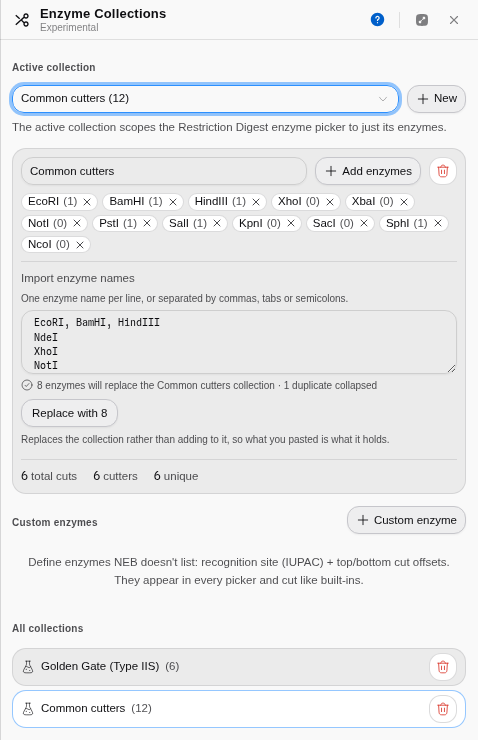 The summary states what will happen before it happens.
-
Now paste a list with three names that are not catalogue names —
EcoR1(digit one, not the letter I),Bam-HI,SgrDI. The import refuses and names all three.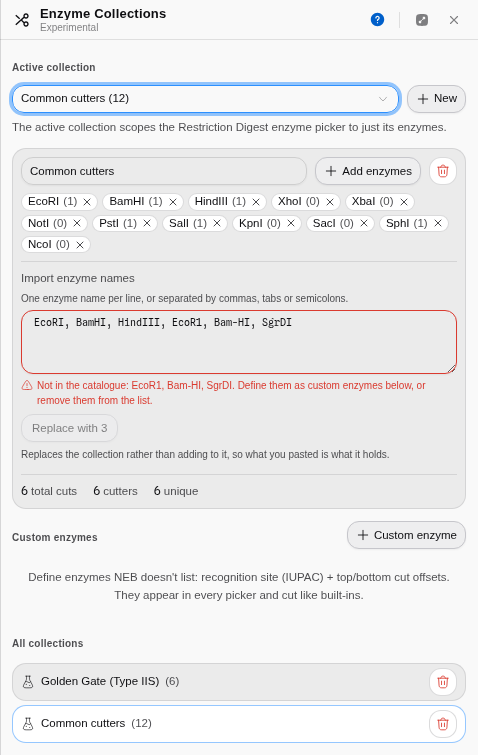 Nothing is imported while any name is unrecognised.
-
Switch to Restriction Digest and use Load collection on a lane. The digest runs against the whole set at once and gives pBR322's six fragments: 2,960 · 748 · 346 · 191 · 85 · 31 bp, summing to 4,361.
Controls
- Active collection — the collection that scopes the Restriction Digest picker, or Whole catalogue (no scoping). This is a scope, not a filter on the science: an enzyme outside the active collection still cuts if you name it another way.
- New — create a collection.
- Rename / delete a collection. Deleting asks first and names what it is deleting.
- Add enzymes — a searchable picker over the whole catalogue plus your customs, each entry carrying its cut count on the open sequence and a IIS badge where it applies.
- Enzyme chips — the collection's members, each with its live count. Clicking a chip removes it.
- One row per recognition sequence — lists a custom enzyme once per site it recognises, rather than once per enzyme.
- Import enzyme names — a whole list in one paste: newline, comma, tab or semicolon separated. Duplicates collapse, unrecognised names refuse the import, and the summary tells you both before you commit. It replaces the collection rather than merging, so what you pasted is what it holds.
- The cut census — total cuts · cutters · unique cutters for the active collection on the open sequence. Unique is the number that matters when you are choosing a cloning site: an enzyme that cuts once gives you a place to put something.
- Custom enzyme — name, recognition site (IUPAC, so
GGWCCis allowed), top-strand cut offset and bottom-strand cut offset, plus optional type and supplier. The two offsets are what make the enzyme: equal offsets are a blunt cutter, top-before-bottom leaves a 5′ overhang, bottom-before-top a 3′ overhang, and an offset beyond the site length is Type IIS. - All collections — every collection with its size, and delete.
The science
Why the cut count and not the site. A recognition sequence tells you what an enzyme looks for; it
does not tell you what it will do to the molecule in front of you. GAATTC is a single site in
pBR322 and a multiple cutter in plenty of other constructs of similar size — the sequence decides,
not the enzyme. The panel resolves the sites against the open sequence, on both strands, with
circularity respected, so what you read is what the digest will do.
Why Type IIS is flagged separately. Type II enzymes cut inside the sequence they recognise; Type IIS enzymes recognise one sequence and cut a fixed distance away, outside it. That is what makes them the basis of scarless assembly — the overhang they leave is your sequence, not theirs — and it is also why a Type IIS enzyme's cut position cannot be read off its recognition site.
Overhangs come from the two offsets, not from a label. An enzyme's two cut positions, one per strand, are the whole story: their difference is the overhang's length and its sign is the overhang's kind. A custom enzyme is declared in exactly those terms for that reason — there is no "5′ overhang" checkbox to get out of step with the numbers.
Limitations
- The catalogue is a copy, and the authority is REBASE. Cut sites and specificities here are checked against REBASE; where REBASE states no cleavage position for an enzyme, the app says cleavage position not determined rather than inventing one.
- A collection is a scope, not a purity guarantee. Setting one active narrows what the digest picker offers; it does not stop another tool from using an enzyme outside it.
- Custom enzymes are yours alone. They live in this browser, travel with no project, and are not written into an exported GenBank file.
- Star activity and methylation are not modelled by the count. An enzyme that cuts once here can cut elsewhere under permissive conditions, and can be blocked entirely on a Dam⁺ or Dcm⁺ prep — the enzyme's own record in the digest panel reports its host-methylation sensitivity and names an isoschizomer that escapes it.
Compared with other tools
Catalogues in the incumbents are a list you filter; here it is a list measured against your construct, and the measurement is the primary datum on every row. Three things this panel does that a filter cannot: it flags Type IIS as a property of the enzyme rather than leaving you to know it, it lets you declare an enzyme the catalogue does not have and then treats it as real everywhere, and it takes a whole pasted enzyme list as input — refusing rather than half-importing — so a protocol's enzyme set becomes a collection in one paste.
Provenance
Cut positions, recognition sequences, isoschizomer relationships and host-methylation sensitivities are checked against REBASE, the field's authority for restriction enzymes, rather than against a list maintained here. Where REBASE records no cleavage position for an enzyme, this app says so instead of drawing a cut. Custom enzymes are the one exception and are labelled as such wherever they appear: REBASE has no record of an enzyme you declared, so what you declared is what is shown.
Related
- Restriction Digest — the tool a collection scopes, and the one that loads a whole collection into a lane.
- Virtual Gel Bench — where the fragments end up.
- Restriction enzymes — the background.