
CODEHOP hybrid primers from a protein alignment
Marked experimental: the surface can change.
Design primers for genes you have never sequenced, in organisms nobody has sequenced, using the one thing that survives deep divergence: the protein. The input is an alignment of amino acids, and the output is a hybrid oligo whose 3-prime end is degenerate over a conserved motif and whose 5-prime end is an ordinary, non-degenerate primer.
| Reached by | Tools → Primer Designer → CODEHOP · command palette → CODEHOP hybrid primers from a protein alignment |
| Sample project | Primer test — kinase-queries.fasta, three human protein kinases and one deliberate non-member |
The problem CODEHOP solves, which the Degenerate tab cannot
The Degenerate tab designs across a nucleotide alignment. That works while the family's DNA still aligns. Past roughly 70% nucleotide identity it stops working, for a reason no amount of degeneracy fixes: the third base of most codons is free to change without changing the protein, so distant homologues have accumulated silent differences everywhere, and a primer that covers them all is a primer that covers everything.
Proteins do not drift that way. A catalytic motif — the kinase HRDLKPEN, a polymerase YGDTDS, a
protease catalytic triad — is under selection and stays put for hundreds of millions of years. So the
right move is to design from the amino acids and let the genetic code fill in the bases.
Doing that naively gives you a fully degenerate primer, and its degeneracy is ruinous: four conserved residues span twelve nucleotides, and even a favourable motif runs to hundreds or thousands of molecules. Split across your ordered concentration, no single correct variant is abundant enough to prime.
A CODEHOP is the fix, and it is one primer with two halves:
- a short 3-prime degenerate core, 11 or 12 bases over three to four highly conserved residues. This is the half that has to match the unknown template exactly, because the 3-prime end is where polymerase extends from;
- a longer 5-prime consensus clamp, typically around 20 bases, which is not degenerate at all: it carries the single most probable nucleotide at each position, predicted from the family's consensus protein and the codon usage of the organism you will amplify from.
The clamp does not have to match perfectly. In the first cycles it mismatches freely; what it provides is duplex stability, so the short degenerate core can anneal at a useful temperature instead of at the 25 °C an 11-mer would otherwise need. From cycle three onward the products carry the clamp's exact sequence, and the primer becomes a high-Tm, non-degenerate primer against its own earlier product.
That is why the pool can be small: the degeneracy is spent only where it must be.
What this computes
The blocks — the ungapped stretches of the protein alignment, each with its identity, which are the only places a consensus-degenerate hybrid primer can be anchored.
Per candidate primer — the 3′ degenerate core over three or four conserved residues, written as IUPAC and also as its single most probable sequence (the string the run and GC checks read, and the one to search a database with); the 5′ consensus clamp, back-translated through the codon usage of the organism you will amplify from; the core's degeneracy; the clamp's melting temperature and its summed log-odds score in bits; the residues the core spans; and the alignment columns both halves cover.
As a ranking — least degenerate core first, then clamp score, which is the method's own rule. The panel states where the selected primer sits in that order, with its degeneracy against your ceiling and its clamp temperature against your target, and says what a lower rank means: a bigger pool of molecules, not a worse clamp.
Why a run returns nothing — counted per reason (no block long enough, every core past the degeneracy ceiling, no clamp reaching the target temperature), so an empty result names the constraint that bound rather than leaving you to guess.
What is not computed — a nucleotide position on any construct you have open. A CODEHOP is designed from protein columns and back-translated, so there is nothing to draw on a DNA map; the alignment is where its coordinates live.
When to reach for it, and when not to
Reach for it when:
- you are cloning a gene family member from an organism with no genome sequence, using distant relatives;
- you are hunting for new members of a family — the method was designed for discovering novel herpesvirus and papillomavirus genomes, and is still used that way;
- your target is diverse enough that nucleotide-level design fails, but a conserved protein motif exists.
Do not reach for it when you have the target's DNA, or when the family is close enough for the Degenerate tab: a CODEHOP is deliberately unspecific and will find related genes you did not ask for, which is the point when you are prospecting and a nuisance when you are not.
Step by step
The panel is arranged in the order the method runs.
1 · Give it a protein alignment
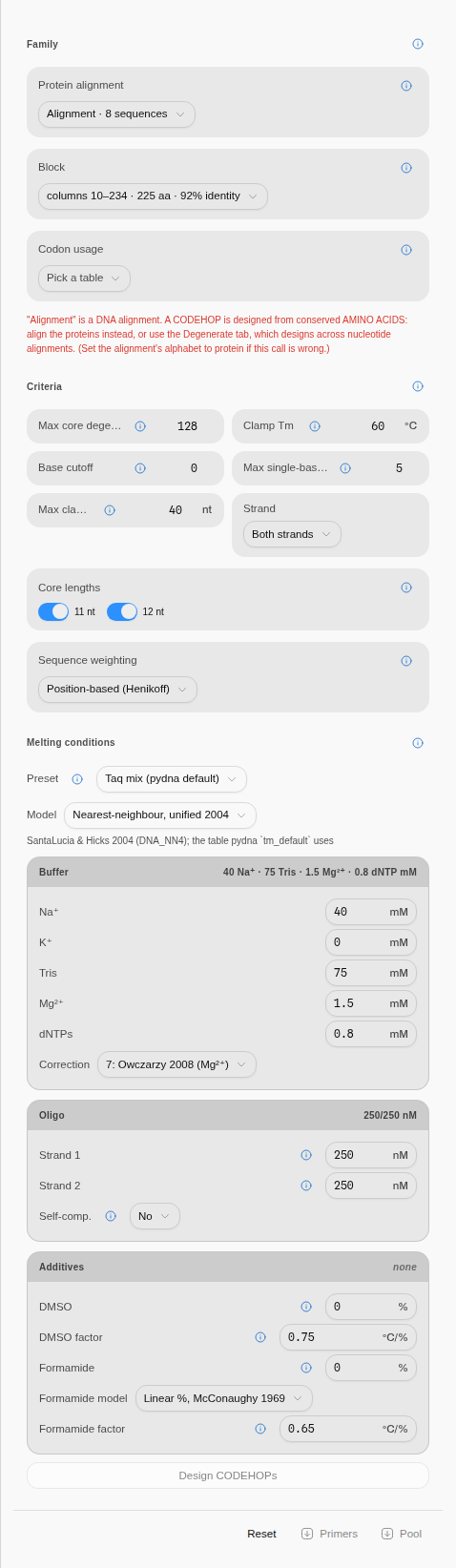
Align the family first (Tools → Multiple Sequence Alignment), then pick that tab in Protein alignment. Three sequences is the minimum: with two there is no consensus to speak of, only a comparison.
The tab refuses a nucleotide alignment by name and points you at the Degenerate tab instead, rather than back-translating something that was never a protein.
2 · Choose the block
A primer cannot span a gap, so a design runs inside one ungapped window of the alignment. The Block control lists every window of eight residues or more, longest first, each with its own identity so you can tell a long weak one from a short conserved one. Identity is what decides whether anything is designable at all: a 40% block will not produce a core under any ceiling.
On the sample project's three kinases the best window is columns 238–281, 44 residues at 64% identity, and it contains the activation-segment motif every kinase shares.
3 · Name the organism you will amplify from
Two controls, and they answer different questions about the same organism.
Genetic code decides which codons encode each amino acid, so it decides the degenerate core:
the core stands for every codon of the three or four residues it covers, and arginine has six codons
under the standard code but only four in vertebrate mitochondria, where AGA and AGG are stops.
Leave it on 1. Standard for nuclear DNA. Change it whenever the template is not nuclear — a
mitochondrial gene, a ciliate, a Mycoplasma — because a core built under the wrong code stands for
codons the template never uses and misses codons it does.
Codon usage decides which of those codons the organism prefers, so it decides the 5-prime clamp. Every base of the clamp is a back-translation, and this table picks it. Amplifying from a plant with the human table gives a clamp that is wrong at the positions where the two organisms disagree, and nothing downstream will tell you.
The two must agree with each other. The usage list includes mitochondrial tables — mitochondrion Homo sapiens, mitochondrion Drosophila melanogaster and others — and picking one of those while the genetic code is still Standard is the mismatch worth watching for: the clamp is built from mitochondrial base frequencies while the core is built from the nuclear codon families.
4 · Set the two published criteria
- Max core degeneracy — how many distinct molecules the 3-prime core may stand for. The published default is 128, and lower is better where the block allows it.
- Clamp Tm — the clamp grows 5-prime one base at a time until it melts at this temperature. 60 °C is the published default and usually gives about 20 bases. Raise it for a longer, more stable clamp at the cost of a longer oligo.
Two more controls are yours to reason about:
- Base cutoff decides which bases enter the core. At
0, every base any observed residue could use is included: nothing is missed, and on a diverged block that can push every candidate past the ceiling. Raising it drops rare bases — at0.25the core keeps only bases the matrix favours over chance, which is often what makes a diverged family designable. On the sample kinases the same block gives one usable primer at0, thirty at0.25and seventy-three at0.35, the best of them eight-fold rather than 128-fold degenerate. Push it high enough and a position can end up with no base above the threshold at all; that is not an error and not a gap — it means nothing at that position beats chance, so the position is writtenNand counts four-fold. - Core lengths are the published 11 and 12. An 11-mer spans four codons minus the last wobble base; a 12-mer spans four whole codons.
Sequence weighting is on by default and is worth understanding: it weights each sequence by how much new information it carries, so a clade that happens to have been sequenced forty times does not decide the consensus on its own.
5 · Read the answer
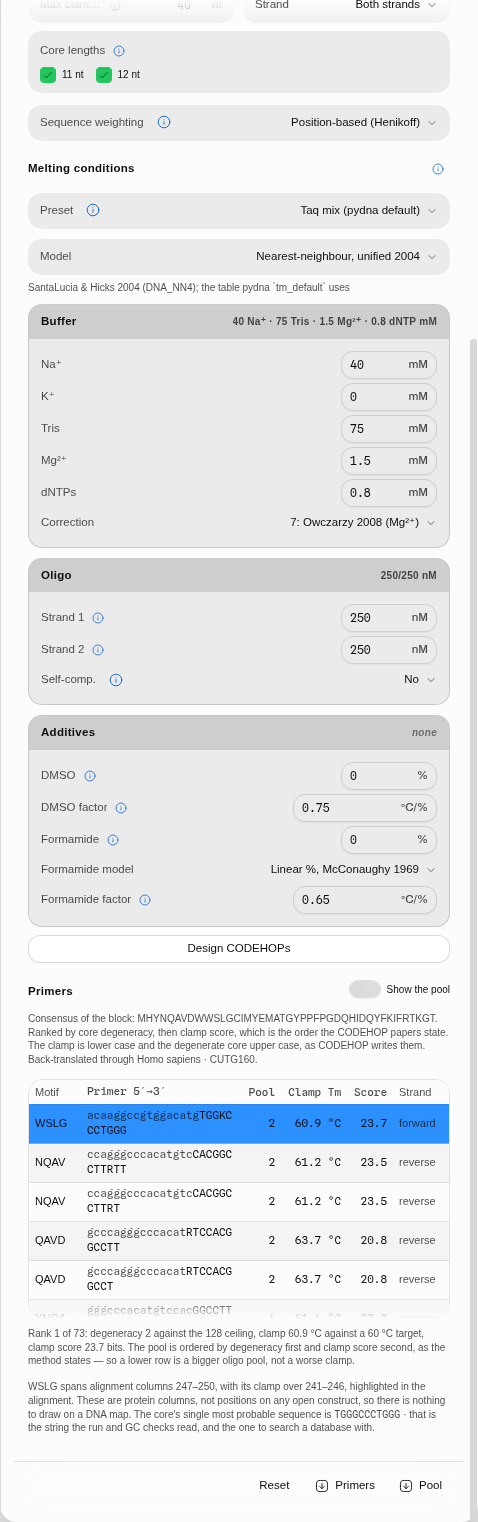
Primers are ranked exactly as the method states: least degenerate core first, then best clamp score. Each row shows
- the motif — the conserved residues the core covers;
- the primer, written the way CODEHOP writes it: clamp in lower case, degenerate core in upper case IUPAC;
- the pool — how many molecules the synthesis makes;
- the clamp Tm, measured with the same nearest-neighbour model and buffer the rest of the Primer Designer uses, and adjustable in the same place;
- the clamp score, which is how well the clamp matches the block. It only breaks ties between equally degenerate cores.
On the sample project the best answers are two-fold pools over WSLG and NQAV; the frame above has
acaaggccgtggacatgTGGKCCCTGGG selected — a pool of two, clamp melting at 60.9 °C, over the motif
WSLG in the kinase activation segment.
Under the table the panel states where that rank came from: "Rank 1 of 73: degeneracy 2 against the 128 ceiling, clamp 60.9 °C against a 60 °C target, clamp score 23.7 bits." It also says which way to read the list, because the ordering is not the intuitive one: a lower row is a bigger oligo pool, not a worse clamp. Two primers with the same degeneracy are separated by clamp score; two with different degeneracies are not comparable on clamp score at all.
Selecting a row scrolls the alignment to the motif and bands the whole core across every track, so you can see the residues the primer is standing on and how far they vary between the homologues. The readout under the table names the alignment columns the core covers, the columns the clamp covers, and the core's single most probable sequence — the string to search a database with if you want to know what else the pool might prime.
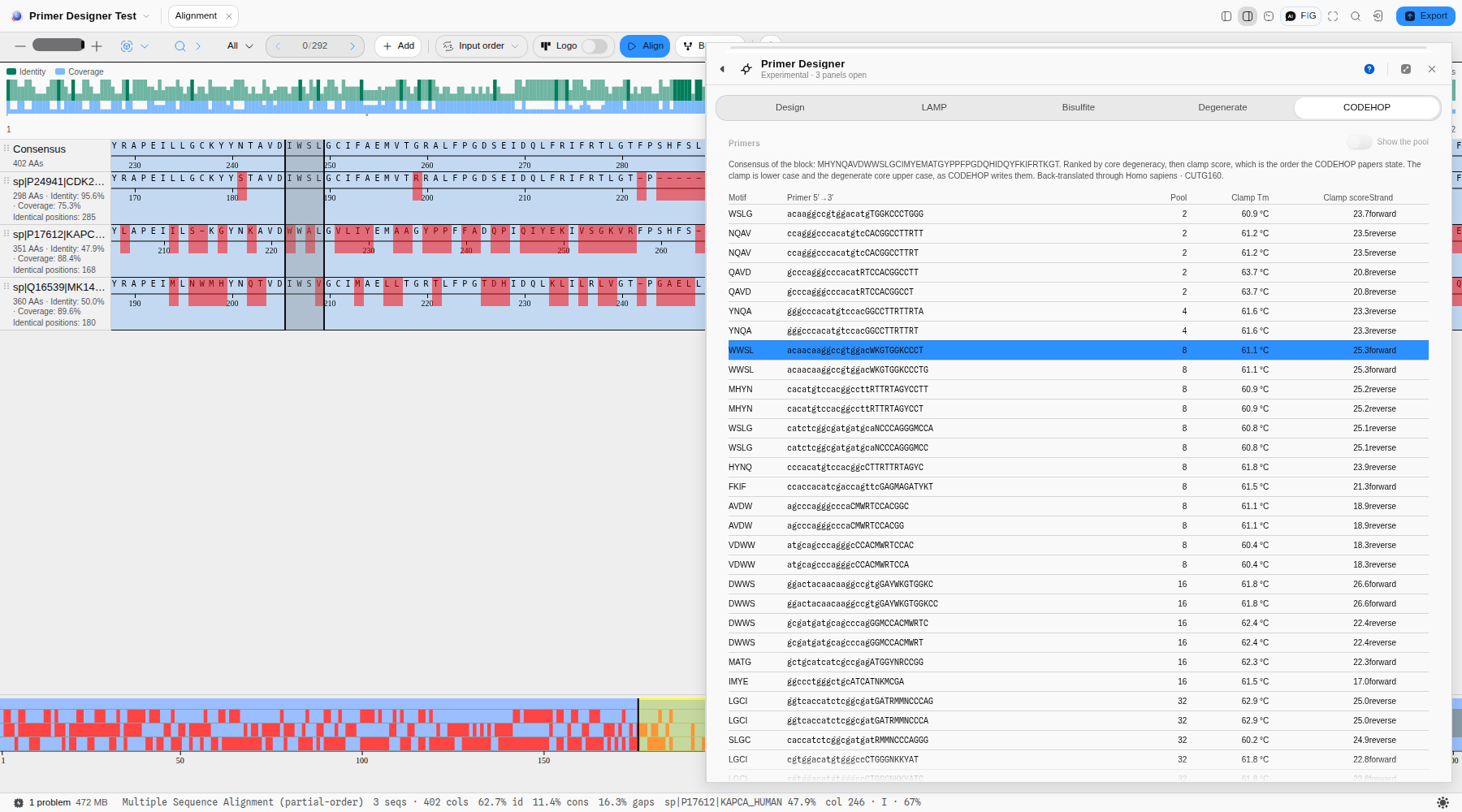
Show the pool expands the selected primer into every molecule the tube will contain. The clamp is identical in all of them; only the core varies.
Pitfalls
-
A single outlier destroys a block. The sample file deliberately contains haemoglobin beta alongside three kinases. Align all four and there is no design at all: the alignment still offers a block, but every one of its 44 candidate cores fails on the same criterion, because a core has to end on a position that is invariant across the family and one unrelated protein removes that everywhere. The tab says exactly that, with the count, rather than returning a worse primer as if it were the best one.
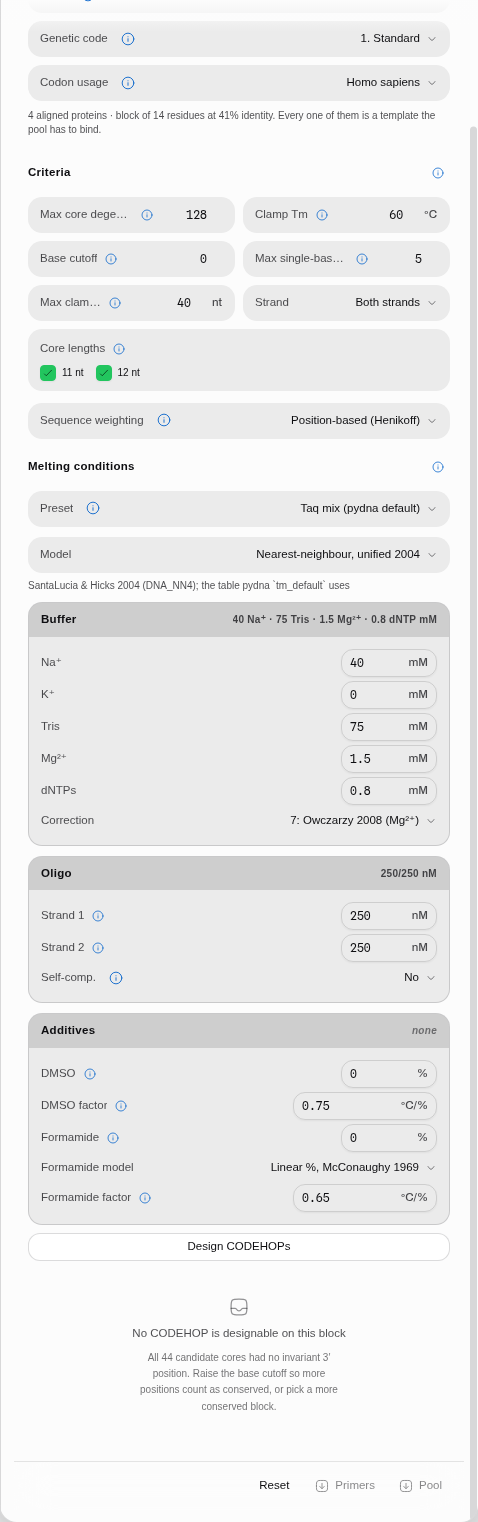
The picker selects per RECORD, not just per file, so the fix is one checkbox: align the three kinases and the same block yields seventy-three primers. Align the family, not the folder.
-
Degeneracy at the ceiling is a warning, not a success. A pool of 128 means each variant is under 1% of your ordered concentration. Prefer a different block, or raise the base cutoff, before accepting it.
-
The clamp is not a guarantee of specificity. A CODEHOP is designed to catch relatives, so expect extra bands and sequence what you get. Nested or touchdown PCR is standard practice with these primers.
-
The genetic code and the codon usage must name the same compartment. The usage list carries mitochondrial tables, and picking one while the genetic code is still Standard builds the clamp from mitochondrial base frequencies and the core from nuclear codon families. Neither half will complain, and the pool will simply be missing variants the template uses.
-
Codon usage is about the organism you amplify FROM, not about the organisms in your alignment. Those are often different: the alignment is the family across species, the template is the one species on your bench.
-
A block with no invariant nucleotide has no core. The core must end on a base that is the same in every codon the family could use. When nothing is designable the panel says which criterion each candidate failed rather than showing an empty table.
What it hands to and takes from other tools
- Takes its input from the Multiple Sequence Alignment tab, the same seam the Degenerate designer and the phylogenetics tools read.
- Gives back a column selection on the alignment canvas, so the motif is visible where it lives.
- Exports the ranked primers as TSV with alignment coordinates, and the selected pool as FASTA — the shape an ordering form and a specificity screen both take.
- Shares its melting-temperature buffer and model with every other tab of the Primer Designer, so a clamp's Tm here and a primer's Tm there are answers to the same physical question.
Where the correctness comes from
The method is Rose et al., Nucleic Acids Research 26
(1998), with the algorithm as the 2003 CODEHOP paper states it step by step and the melting temperature computed by the modern nearest-neighbour method the 2009 iCODEHOP revision adopted. The original program's servers no longer exist, so this implementation follows the published rules and every number it reports is recomputed independently in its tests: the pool size by expanding the pool, the clamp by re-deriving the most probable base at each position, the coverage by checking that every codon of every residue the family holds is present, and the clamp length by confirming that one base shorter would not reach the target temperature. The codon-usage tables are the real published ones, including the set the original CODEHOP server itself served.