
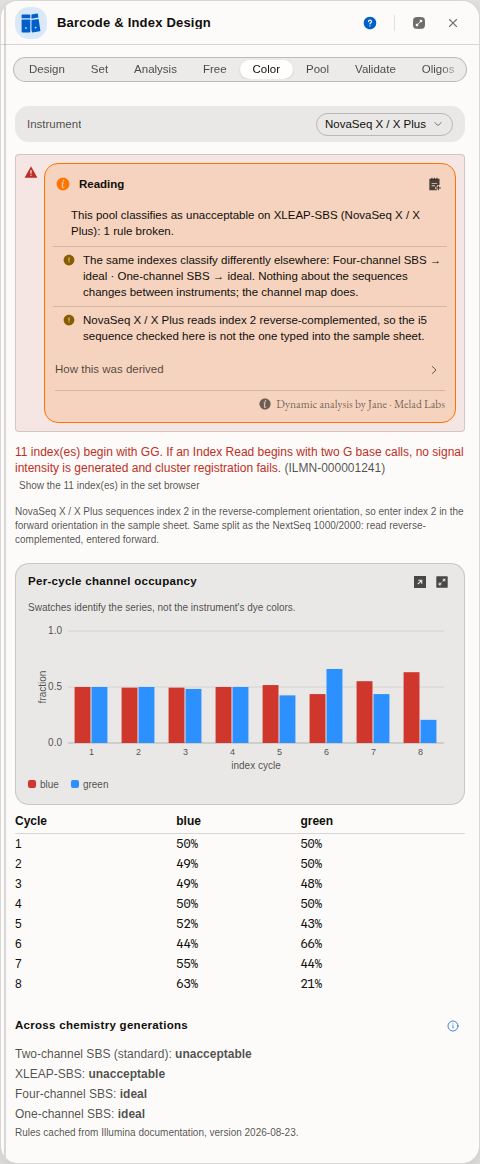
Per-cycle channel occupancy
What fraction of the pool lights each imaging channel at each index cycle, for the chemistry of the instrument you picked.
What it does
An Illumina instrument does not see bases; it sees dye channels. How many channels there are, and which base lights which, depends on the chemistry — and on the two-channel chemistries G is dark: it carries no dye at all, and is called by the absence of signal in both channels.
That has a consequence which is invisible in a list of index sequences. If every index in your pool reads G at the same cycle, the instrument sees nothing in either channel at that cycle and cannot call it. If the index read starts with GG, cluster registration itself fails.
This plot converts your pool into what the instrument will see. Each column is one index cycle, stacked by channel, showing the fraction of the pool producing signal in each. A column that is missing a channel names it on hover; a column with no signal at all is called out as unsequenceable. The panel's balance report above the plot lists every rule violation in words, with its severity and the vendor document it comes from.
When you'd use this
- Before every pooled run, and especially before a small one. Two or four samples on a two-channel instrument is the classic failure: the more indexes you pool, the more likely some of them light both channels, and the fewer you pool the easier it is to have none.
- When you change instrument. This is the trap worth stating twice: XLEAP-SBS moved the dual-colour base from A to C, so a pool validated on a NovaSeq 6000 is not automatically valid on a NovaSeq X, and nothing about the sequences changes to warn you. Switch the instrument control and watch the plot redraw.
- When a previous run had poor base calls in the index read or samples that failed to demultiplex at all.
- When combining indexes from two kits, where each kit is balanced and the mixture is nobody's responsibility.
What this computes
- Per-cycle channel fractions for the instrument you select, under its own chemistry: four-channel SBS (red / green / blue / yellow, no dark base), two-channel SBS (red / green, G dark, A dual-colour), or XLEAP-SBS (blue / green, G dark, C dual-colour)
- The dark channels at each cycle, and a flag on any cycle where the pool produces no signal at all
- Rule violations with their severity and their source, including that an index read must begin with at least one base other than G in either of the first two cycles (GG at the start prevents cluster registration) and that every index cycle must produce signal in at least one channel
- An overall tier, in the vendor's own words — ideal (signal in both channels at every cycle), acceptable (one channel at some cycles, but enough intensity to sequence), or unacceptable (a cycle with no signal in either channel, or an index read starting GG)
This is the plot that knows about dyes, which is why it sits beside base composition: entropy measures spread, and a cycle can be perfectly balanced between two bases that are both dark on your instrument.
Where it lives
The Colour tab of the Barcode & Index Design panel, under the instrument selector and the balance report. Its section header carries the detach control, which floats it live beside the canvas.
Inputs and outputs
In: the working set, plus the instrument you select. The instrument determines the chemistry, which determines the channel map and which rules apply.
Out: per-cycle channel fractions; the dark channels at each cycle; a flag on any cycle where the pool produces no signal at all; the list of rule violations with severities; and an overall tier — ideal, acceptable or unacceptable.
The tiers are the vendor's own, and they mean: ideal, signal in both channels at every cycle; acceptable, signal in only one channel at some cycles but enough intensity to sequence; unacceptable, a cycle with no signal in either channel, or an index read starting with GG.
Screenshots
Controls
| Control | What it changes |
|---|---|
| Instrument | The chemistry, and therefore the channel map, the rule set and the plot. iSeq 100, MiniSeq, NextSeq 500/550, NextSeq 1000/2000, NovaSeq 6000, NovaSeq X / X Plus, MiSeq and HiSeq 2500 are offered, each carrying its own index-2 orientation. |
| The working set | The pool being checked. |
| Detach | Floats the plot. |
The science
Three chemistry generations are modelled, each with its own channel assignment:
| Chemistry | Channels | Dark base | Dual-colour base |
|---|---|---|---|
| Four-channel SBS | red, green, blue, yellow | none | — |
| Two-channel SBS | red, green | G | A |
| XLEAP-SBS | blue, green | G | C |
Four rules are applied, and each carries its severity and its source:
- An index read must begin with at least one base other than G in either of the first two cycles (error). GG at the start of an index read prevents cluster registration.
- At every index cycle the pool must produce signal in at least one channel (error). A fully dark cycle cannot be called.
- Prefer signal in both channels at every cycle (warning). This is the difference between the ideal and acceptable tiers.
- Index 2 orientation (warning, XLEAP only). NextSeq 1000/2000 and NovaSeq X / X Plus sequence index 2 in the reverse-complement orientation while the analysis software expects it forward — a sample-sheet error that looks like a failed pool.
The rules and channel maps are not written into the software. They come from a versioned dataset sourced from Illumina's own knowledge-base articles, carrying the retrieval date and the article identifiers, and refreshed by re-reading them. Illumina is the authority for its own chemistries, and channel assignments change between generations — which is exactly how XLEAP would have silently invalidated a hardcoded table.
Limitations
- Illumina chemistries only. Nanopore, Element, Ultima and PacBio have different failure modes and are not modelled here; an index set can be checked for distance on this panel regardless of platform, but the colour check is Illumina-specific.
- It weights every index equally. A pool loaded at deliberately unequal molarity has a different effective balance, and this plot does not know your loading plan.
- The rules are vendor guidance for the listed articles' chemistries, not a simulation of the optics. A pool that passes here can still fail for reasons the guidance does not cover — low diversity in the insert, over-clustering, a bad library.
- The dataset is a cache, refreshable from the vendor articles it names. If your instrument's chemistry is newer than the recorded retrieval date, re-check against the current article.
Related
In this group: Edit annotation · Enzyme · Insert sequence · Merge features · Manage enzymes · Dot plot · Dot plot grid · Melt curve · Amplification curves · Population genetics · RNA-seq · Site avoidance heat map · Protein coverage · Reference-gene stability · Digital PCR · Codon usage matrix · Pairwise distance distribution · Nearest-neighbor distances · GC content distribution · Base composition per cycle · Pairwise distance grid · Grammar assembly plan · Gibson assembly plan · Assembly plan build order · Golden Gate assembly plan · Guide track · Primer binding track · Hydropathy profile · Charge vs pH · Amino-acid composition · Hydrophobic moment · Optimization profiles · Digest gel · Virtual gel · Initiation-window fold · Antibody domain map · Electropherogram · Circuit netlist · Circuit transfer functions · Circuit construct · Construction graph · Protocol · Read Quality Profile · Read Alignment · Raw Signal · Verify vs Reference · Chromosomal microarray · Variant calls · Small molecule
Pairwise distance grid
Every barcode against every other as a heatmap, so a cluster of confusable members is a visible block rather than a row in a table.
Grammar assembly plan
A multi-part Type IIS build drawn as the graph it is: which parts join at which fusion site, in the order the overhangs force.