
Compare to reference
| Document kind | compare |
| Drawn from | a tool result — there is no file behind it |
What it draws
The multi-sample variant workspace: a table of every position where at least one sample differs from a reference, beside the aligned bases themselves.
The table has one row per variant position and one column per sample, so reading across a row tells you which samples carry the change and which do not. That is the layout a clone-screening question actually has — you are rarely asking "what is in read 3", you are asking "which of my twelve colonies has the edit".
The panel beside it draws the same region as aligned sequence, anchored on the reference, with disagreements marked. Selecting a row in the table moves the alignment to that position, so the table is the index and the alignment is the evidence.
What opens in it
The result of comparing a set of sequencing reads to a reference sequence. Reads come from trace files or from sequence you provide; the reference is the construct you are checking against.
A single read against a target, graded pass or fail, is the verification canvas. A read's raw peaks are the chromatogram canvas. This canvas is specifically for several samples at once, compared at the same positions.
What this computes
This canvas computes the comparison itself, which is why it exists as a surface rather than as a table someone else filled in.
- The alignment of every sample to the reference, and from it every position where at least one sample differs — the row set of the table is a computed result, not a list you supply.
- Per-sample state at each of those positions, one column per sample, so reading across a row answers the question a clone screen actually asks: which of my twelve colonies has the edit.
- Coverage as distinct from agreement. A sample whose read did not reach a position cannot disagree with the reference there, and that is a different fact from agreeing with it. Both would otherwise render as a match, and the table keeps them apart.
- Reference-anchored numbering. Every position is numbered against the reference rather than against each sample's own coordinates, because an insertion in one sample would shift all its subsequent positions and the table would stop being readable across a row.
- The consequence of a change inside a coding feature, with the genetic code used to interpret it stated. That code is a choice and not a constant: the same change is silent under one and a stop under another.
A variant row is a position, not a conclusion. A sample that differs may carry a real mutation, a base-calling error, or the ragged edge of a read where quality falls away — which is why the aligned bases sit beside the table rather than in another tab, and why the trace behind them is one click away.
Reading it
The reference is the anchor, and every position is numbered against it. A sample's own numbering is not used, because an insertion in one sample would shift every subsequent position and the table would stop being readable across a row.
A cell that matches the reference is not evidence that the position was read. It matters whether a sample was covered at that position at all — a sample whose read did not reach a position cannot disagree with the reference there, and that is a different fact from agreeing with it. The table distinguishes the two rather than showing both as a match.
A variant row is a position, not a conclusion. A position where one sample differs may be a real mutation, a base-calling error, or the edge of a read where quality falls away. The alignment beside the table, and the trace behind it, are what tell those apart — which is why this canvas puts the alignment next to the table rather than in a different tab.
Where a change falls inside a coding feature, the genetic code used to interpret it is stated. It is a choice, not a constant: the same change is silent under one code and a stop under another.
Controls
The table is a full data table: sort by any column, filter per column, resize columns. Filtering to the positions inside one feature is the commonest use.
A draggable split sets how the width is shared between table and alignment. Widen the table when comparing many samples; widen the alignment when reading one region closely. The split is the control that makes this canvas work at both of its jobs.
Selecting a row drives the detail readout — per-read summary, the selected variant in full, the genetic code, and export.
Where it appears
As a stage tab. Its detail readout sits in the right rail, which keeps the tab itself purely the data — the table and the alignment — and gives the summary somewhere to live that does not steal width from either.
Performance and limits
Table rows are windowed, so a comparison producing thousands of variant positions scrolls smoothly; only the rows on screen are drawn.
The limit worth stating: this canvas compares called bases. A position where the base call is ambiguous is reported as ambiguous rather than resolved, and resolving it means looking at the trace. A comparison over reads with no quality information behind them — pasted sequence, for instance — can show you a disagreement but can never tell you how much to believe it.
Screenshots
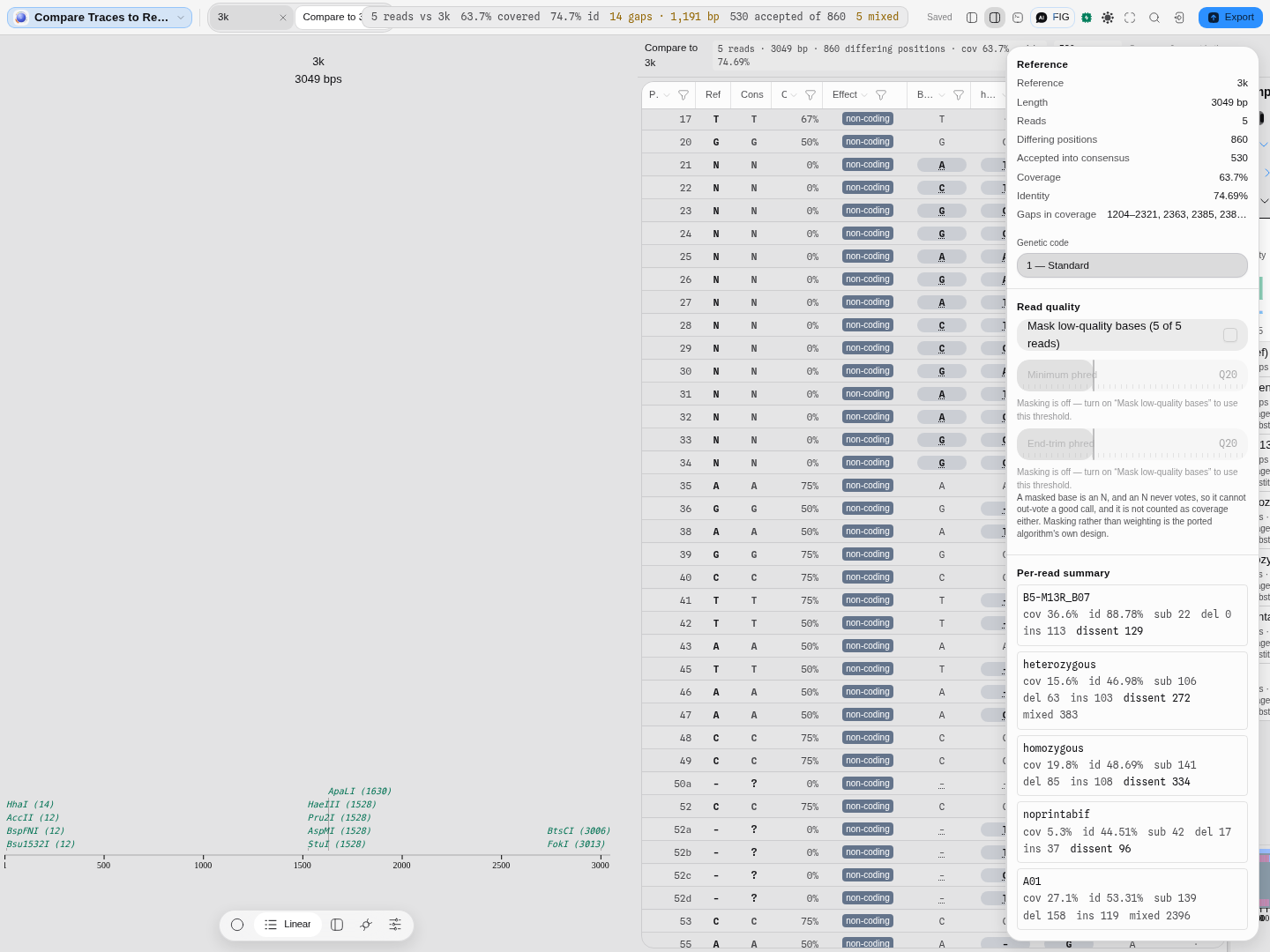 Five reads against the
3k reference: 3,049 bp · 860 differing positions · 530 accepted into
consensus · coverage 63.7% · identity 74.69%, with the gaps in coverage listed rather than implied.
Each row carries the reference base, the consensus call, the fraction of reads voting for it and its
coding effect; each read gets its own line of coverage, identity, substitutions, deletions,
insertions and dissents. The masking controls are visible disabled, with the reason under them —
masking is off, and a masked base is an N that can neither out-vote a good call nor count as
coverage, which is the ported algorithm's own design rather than a choice made here.
Related
The chromatogram canvas, for the peaks behind a called difference; the verification canvas, for a pass/fail grade rather than a position-by-position table; the alignment canvas, for reading samples against each other rather than all against a reference.
Text viewer
Any file read as plain text with line numbers: the viewer of last resort, so every file in a project can be opened.
Digest result
The digest result is the answer to 'what did my enzymes actually do to this molecule': the gel those fragments would run, and the table of every fragment with the cutter and overhang at each of its two ends.