
Assembly report
| Document kind | report |
| Drawn from | a tool result — there is no file behind it |
What it draws
The report is what an assembly run shows you once it has finished: the fragments your enzyme actually produced, which of them can join to which, and — for a Type IIS assembly — the slots those joins define. It is the same report under Golden Gate, Grammar Assembly, Gibson and Ligation, because they are all asking one question in different chemistries: given these parts, what closes?
Three figures do the work, and they answer three different questions.
The fragment schematics. One rail per fragment the digest produced, in the order the reaction produced them, with the fragment's own annotations packed into lanes underneath and its two overhangs drawn as half-height steps at each end. A fragment appearing twice from one part is a real result, not a duplicate — a part cut at two sites gives two fragments, and each is numbered by its occurrence so you can tell them apart.
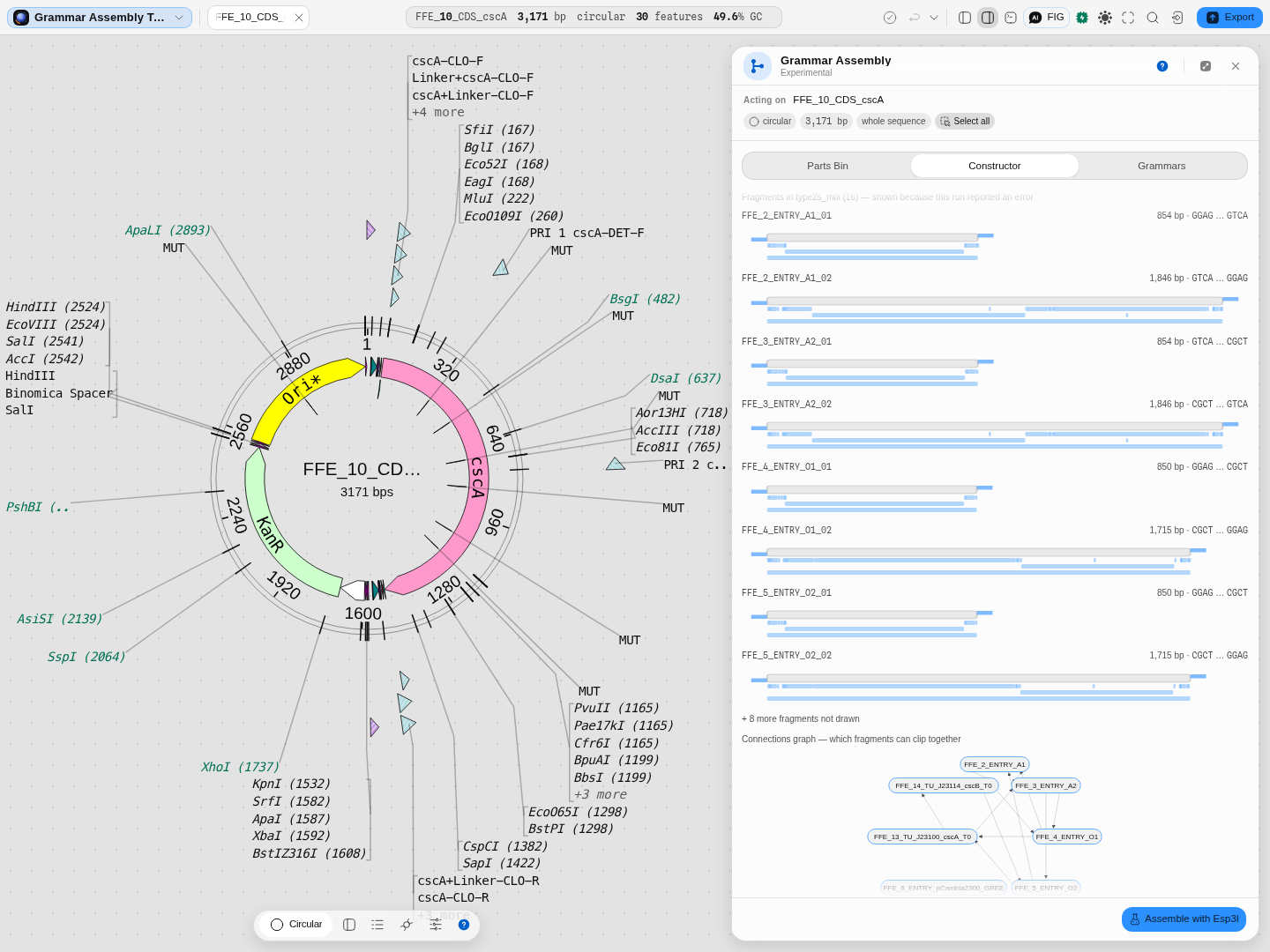
Ten MoClo Level-0 parts digested with Esp3I. Each caption reads length · left overhang … right overhang; the rails share one scale, so a 854 bp off-cut and a 1,846 bp insert are drawn at the
sizes they actually are.
The connections graph. Which fragments can clip together. An edge means two fragments carry compatible overhangs and can be ligated in that direction — it does not mean they end up in your construct, only that the chemistry permits the join. Each fragment appears once even though a digest produces both its orientations, so a mix is not drawn twice for what is really one topology.
The slots graph. Only Type IIS assemblies have one. A slot is a pair of overhangs, and every part that presents that pair is interchangeable at that position — this is the figure that tells you your assembly is combinatorial. The numbered legend under the graph names the parts sharing each slot, and a shared overhang between two slots is drawn as the node that joins them.
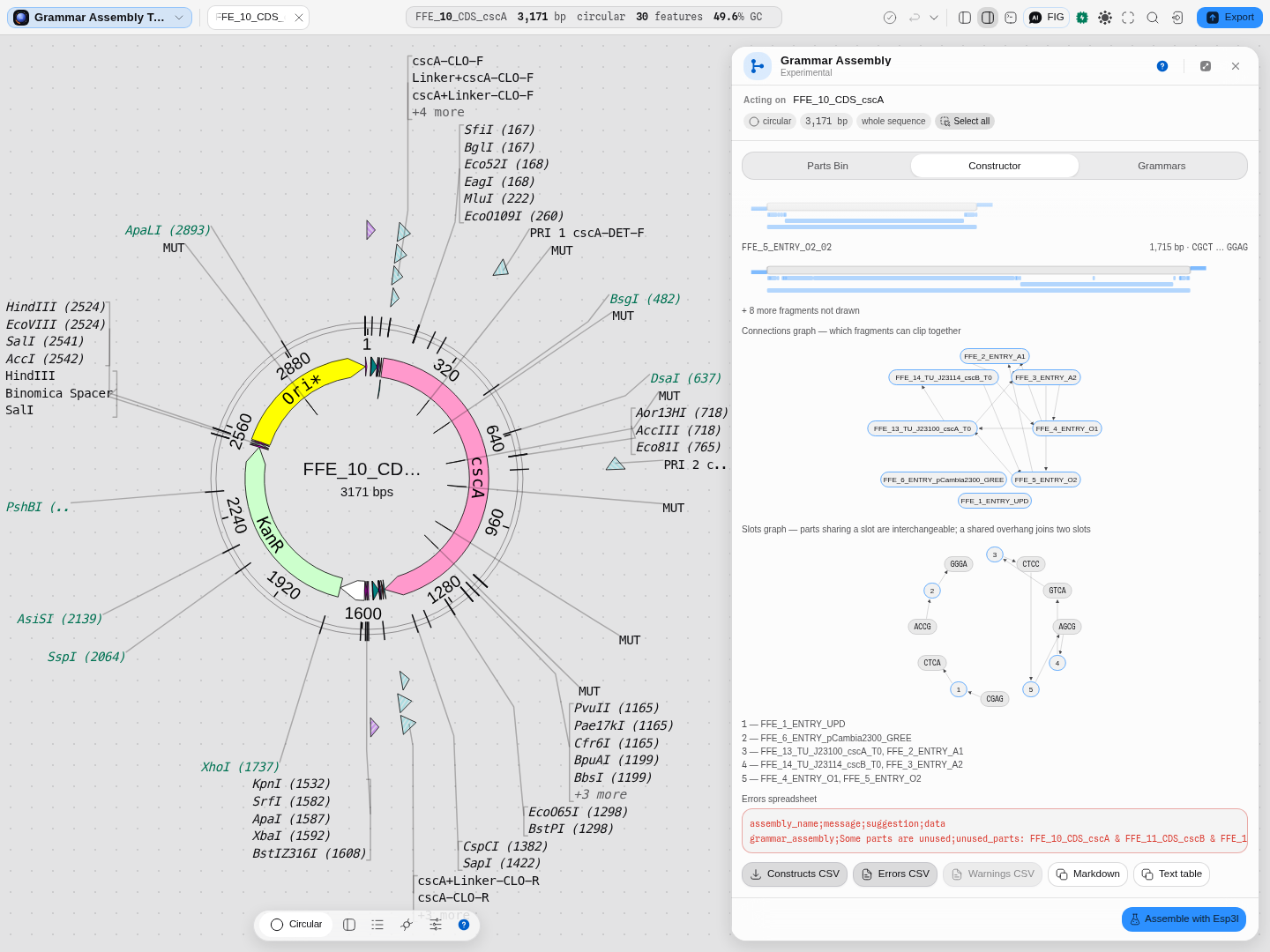
The same run: 8 fragments with 12 possible joins, resolving into 5 slots over 7 distinct overhangs. Slots 3, 4 and 5 each hold two parts, which is why this parts list yields a combinatorial library rather than one construct.
If a run reports an error or a warning, the report also shows the spreadsheets the method writes — errors and warnings separately, each downloadable, with the unused parts and the reason named rather than left for you to infer from an empty result.
What opens in it
Nothing opens in it. There is no file behind an assembly report: it is drawn from a run, and it lasts as long as that run's result does. If you want it to persist, export it — the constructs spreadsheet, the errors and warnings spreadsheets, a Markdown report or a plain text table all leave the panel as files.
What is not here: the assembled construct itself. That opens as a sequence on the map, where you can inspect the junctions base by base. The report is about the reaction; the map is about the product.
What this computes
The assembly run computes the chemistry; this canvas computes the three figures that make its answer readable, and each answers a different question.
- The fragment set the digest actually produced, in reaction order, each with its length and
its two overhangs — drawn as half-height steps at the ends, and named in the caption as
length · left overhang … right overhang. A fragment appearing twice from one part is a real result, not a duplicate: a part cut at two sites gives two fragments, and each is numbered by its occurrence so the two can be told apart. - A shared length scale across every fragment rail, so an 854 bp off-cut and a 1,846 bp insert are drawn at the sizes they actually are rather than each filling its own row.
- Overhang compatibility between every pair of fragments — the connections graph. An edge means the two carry compatible overhangs and the chemistry permits that join; it does not mean they end up in your construct. Each fragment appears once even though a digest produces both orientations, so one topology is not drawn twice.
- Slots, for a Type IIS assembly only. A slot is a pair of overhangs, and every part presenting that pair is interchangeable at that position — this is the figure that tells you your assembly is combinatorial rather than fixed. A shared overhang between two slots is drawn as the node joining them, and the numbered legend names the parts in each slot.
The same three figures are computed under Golden Gate, Grammar Assembly, Gibson and Ligation, because those are one question asked in four chemistries: given these parts, what closes?
Reading it
An overhang caption reads left to right along the top strand. GGAG … GTCA means the fragment
presents GGAG at its left end and GTCA at its right, both written as the top strand reads them,
which is the convention the assembly method itself uses to match ends.
no overhang is not the same claim as a blunt cut. It means this end carries no single-stranded
protrusion the reaction defined — the usual case being the outer end of a fragment cut from a
linear part, which is simply where the molecule you supplied already ended. The report will not
tell you that end is blunt, because the reaction never determined it.
An edge in the connections graph is a possibility, not a plan. Compatible ends can join; whether they do depends on what else is competing for the same overhang. Reading an edge as "these two are adjacent in my construct" is the misreading this figure most invites.
Two parts in one slot means a library. The run returns the combinations that actually close, which is usually fewer than the arithmetic suggests — but if you wanted a single product, untick all but one part per slot rather than assuming the extra ones were ignored.
A fragment drawn short really is short. The rails share one scale across the set, so an enzyme off-cut of a few dozen bases is drawn as a sliver next to a 9 kb backbone. Very short fragments are drawn at a small minimum width so they remain visible; absence would read as "no fragment", which is a different statement.
Controls
The report follows the run: change the parts, the enzyme or the construct limits and it redraws. The controls that change what it contains are the assembly's own — which parts are selected, the enzyme or grammar, and the expected/maximum construct counts, which is what decides whether you see an errors spreadsheet, a warnings spreadsheet, or neither.
Within the report itself: each fragment's title selects that fragment on the map when the part it came from is the open document, and says why it cannot when it is not. Every spreadsheet has its own export, and an export whose data does not exist for this run is shown disabled rather than hidden, so you can tell "no errors" from "errors not available".
Where it appears
In the panel of whichever assembly tool produced it, and — since a report is a document like any other — as its own stage tab when you want it beside the map rather than in the rail.
Performance and limits
A mix routinely produces more fragment schematics than a rail can usefully show, so the list is capped and says how many more exist rather than silently truncating. The graphs place their nodes in the editor: the published method draws them with a force-directed layout whose exact coordinates come from a numerical optimiser, so node positions here are ours while the graph, its edges and every label are the method's own.
Screenshots
Both frames on this page are the real panel on the Grammar assembly (MoClo) starter project
after an Esp3I run over its ten parts. The graphs frame is the whole lower half of the report: the
last fragment rails, both graphs, the numbered slot legend, the errors spreadsheet this run produced,
and the five exports — where Warnings CSV is greyed because this run raised no warnings, not
because the button is broken.
How this is checked
The fragments, their overhangs, the connections graph, the slots and the legend are all verified byte for byte against DnaCauldron 2.0.12, the published implementation of Type IIS assembly simulation, over its own reference parts — including that each part's annotations survive onto the fragments cut from it. Where the two could differ, the published behaviour wins and is reproduced.
Related
Written by Golden Gate Assembly, Grammar Assembly, Gibson Assembly and Ligation. The construct a report describes opens on the sequence map; the fragments it lists can be run on a gel.
Gel
A gel canvas is an agarose run you did not have to pour: lanes of DNA placed against a molecular-weight ladder by a real, published migration model rather than by drawing bands where they look right.
Graph
A node-link diagram of a levelled directed graph, where each node sits in a column set by its distance from the root.